Introduction
The World Economic Forum has, since its founding in 1971, matured into the premier global platform where political leaders, business executives, civil society representatives, academics, and cultural influencers converge to tackle the most pressing issues of our time. Originally established by Klaus Schwab as a forum for European business leaders, the World Economic Forum has evolved into a multistakeholder institution that seeks to shape global, regional, and industry agendas by fostering cooperation across sectors.
Each year, the Annual Meeting in Davos-Klosters, Switzerland, brings together a diverse range of decision-makers to address global economic trends, geopolitical conflicts, technological transformations, and social challenges. In 2026, as the world grapples with deepening geopolitical tensions, technological upheavals, and economic imbalances, the Forum’s relevance and scrutiny alike have intensified.
What Is the World Economic Forum and Why It Matters
At its core, the World Economic Forum is a non-profit foundation headquartered in Geneva, Switzerland, committed to improving the state of the world through public-private cooperation. It operates as a convener of global stakeholders: heads of state, industry leaders, civil society organizations, and academia, enabling dialogue and partnerships on issues that transcend borders.
The World Economic Forum’s mission, articulated on its official platform, emphasizes multi-stakeholder collaboration on shared challenges, including economic resilience, climate sustainability, digital transformation, social inclusion, and health systems strengthening. By generating influential reports, research tools, and initiatives, the Forum aims to inform policy and corporate strategy and act as a catalyst for global action on issues that no single actor can solve alone.
Central to its efforts are its Annual Meeting and an array of initiatives that span workforce readiness, supply chain resilience, and global risks assessment, each shaped through data, expert insights, and collaborative frameworks. The Forum’s reputation stems not just from its high-profile annual gathering in Davos but also from its capacity to surface emerging global trends and mobilize cross-sector responses.
Core Functions and Major Initiatives of the World Economic Forum
The World Economic Forum promotes global cooperation through several key pillars:
Annual Meeting in Davos
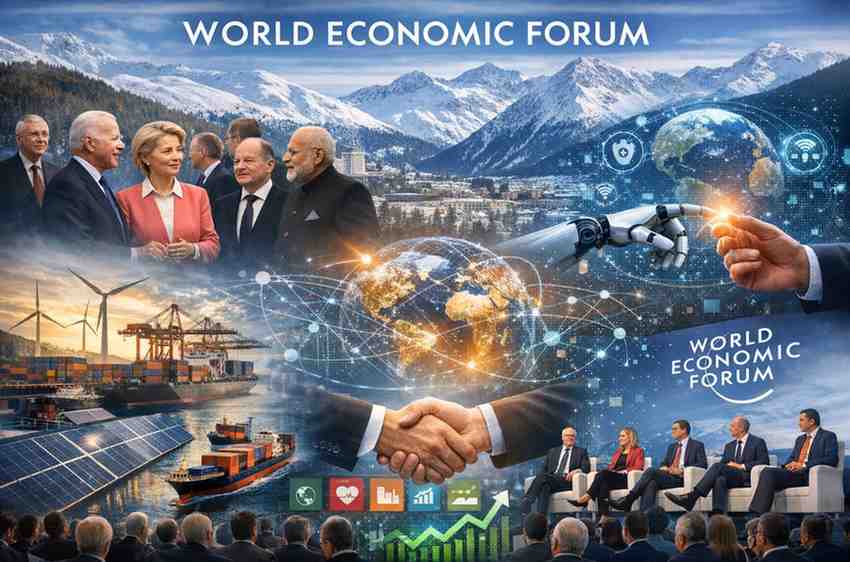
Held every January in Davos-Klosters, the Annual Meeting brings together roughly 3,000 participants from over 130 countries, including heads of state, government ministers, CEOs of major corporations, innovators, academics, and civil society leaders. The 2026 meeting, held under the theme “A Spirit of Dialogue,” is notable for record levels of political participation with approximately 400 top political leaders and nearly 65 heads of state expected to attend as well as nearly 850 CEOs and business chairs and around 100 technology leaders and unicorn founders.
This unique blend of participants reflects World Economic Forum’s strategy of blending voices that are often siloed in traditional diplomacy or corporate governance, facilitating an environment where tough global challenges can be discussed in real time.
Flagship Reports and Publications
Among the World Economic Forum’s most influential contributions are its research reports, which often set the agenda for international policy dialogues:
- The Global Risks Report 2026 highlights economic confrontation as the foremost short-term global risk, reflecting a stark shift where geoeconomic tools such as tariffs, sanctions, and restrictions increasingly challenge international stability.
- Other cornerstone publications include the Future of Jobs Report, which analyzes labor market transformations driven by technology and demographic shifts, and the Global Supply Chain Report, which evaluates structural shifts in global production and distribution.
These reports are widely referenced by policymakers, business leaders, and academics to inform strategy, regulation, and cooperative mechanisms.
Reskilling Revolution
The Reskilling Revolution is one of the Forum’s most ambitious impact initiatives, aiming to equip 1 billion people by 2030 with enhanced skills and better job opportunities through coordinated global actions involving governments, companies, and educational institutions.
As of early 2025, data shows that more than 716 million people worldwide are being reached by this initiative through programs that range from digital literacy to advanced technical training. This effort is grounded in research indicating the urgency of workforce upskilling in the face of rapid technological change and sectoral disruption.
World Economic Forum Annual Meeting 2026: A Spirit of Dialogue Amid Rising Tensions
The World Economic Forum’s 56th Annual Meeting (January 19–23, 2026) is occurring against an exceptionally turbulent global backdrop. Geoeconomic frictions, technological disruptions, widening inequality, and increased mistrust in institutions set the stage for discussions under the banner of dialogue — reflecting a recognition that entrenched divisions require renewed mechanisms for cooperation and understanding.
Record Participation and High-Profile Attendees
According to official Forum documentation, the 2026 Davos meeting is drawing:
- Approximately 400 top political leaders, including at least six G7 leaders
- Nearly 65 heads of state and government
- Close to 850 CEOs and chairs from leading corporations
- About 100 tech innovators and unicorn founders
Participants include U.S. President Donald Trump, Canadian Prime Minister Mark Carney, French President Emmanuel Macron, China’s Vice-Premier He Lifeng, EU Commission President Ursula von der Leyen, and Ukraine’s President Volodymyr Zelenskyy — underscoring both the geopolitical breadth and diversity of perspectives gathered at Davos.
Agenda Highlights and Central Themes
The Annual Meeting agenda centres on global cooperation in an era of fragmentation exploring how to:
- Foster economic growth and job creation in an uncertain world
- Address technological transformations responsibly
- Enhance resilience in global supply chains
- Build prosperity that is inclusive and environmentally sustainable
- Advance understanding across geopolitical divides
Sessions are structured to encourage deep engagement and are accessible to the wider public through live broadcasts of more than 200 sessions, complemented by an Open Forum for community participation.
Key Reports and Strategic Insights from World Economic Forum Research
The Forum’s research outputs are central to its influence on policy discourse. Three reports from the 2025–26 period are particularly noteworthy.
Global Risks Report 2026
The Global Risks Report 2026 reveals a significant shift in expert perceptions of global risk:
- Economic confrontation defined as intensified economic competition and sanctions between nations has surpassed armed conflict as the top short-term risk.
- Economic tools like tariffs and investment restrictions are increasingly employed to secure strategic advantage, reflecting broader geoeconomic tensions.
This reordering of risks underscores how global economic policy is simultaneously a tool for growth and a potential catalyst for instability, particularly in a world where trade and technology are deeply intertwined.
Global Value Chains and Structural Volatility
A concurrent Forum report highlights that global value chains, once optimized primarily for efficiency are now undergoing structural volatility driven by geopolitical fragmentation, trade policy shifts, and resource constraints.
According to this research:
- Nearly three in four business leaders prioritize resilience investments as a critical growth driver.
- Over 3,000 trade and industrial policy measures were adopted worldwide in 2025 alone, reshaping major trade flows.
- Disruptions have raised shipping costs significantly and reduced manufacturing output in key markets.
The Forum introduced a Manufacturing and Supply Chain Readiness Navigator to translate data into actionable strategy for governments and corporations alike, signalling the need for adaptable, future-ready operating models.
Future of Work and Technological Disruption
The Reskilling Revolution initiative emphasizes that technological change is reshaping labour markets dramatically, with an estimated 22% of jobs expected to transform due to AI and automation in the coming years.
The Forum calls for an urgent global effort to close skills gaps, particularly through gender-intentional strategies and targeted investment in fields such as STEM, digital technologies, and emerging industries, asserting that failure to do so will exacerbate inequality even as technological advances create new opportunities.
Influence on Policy, Investment, and Cooperation
The World Economic Forum’s most tangible impact lies not merely in convening dialogue but in shaping policy frameworks, investment flows, and cross-sector cooperation. Over the years, the Forum has evolved into a critical interface where governments, corporations, international organizations, and civil society align priorities, coordinate actions, and translate global challenges into concrete initiatives.
Unlike traditional multilateral institutions, the World Economic Forum does not produce binding agreements. Instead, it exerts influence through agenda-setting, policy modelling, and partnership facilitation, creating a unique ecosystem where ideas move rapidly from discussion to implementation.
Policy Influence and Global Governance
The World Economic Forum plays a strategic role in influencing national and international policy by providing evidence-based insights, benchmarking tools, and policy roadmaps. Its reports, such as the Global Risks Report, Future of Jobs Report, and Global Competitiveness Report, are frequently cited by governments when shaping national strategies on economic growth, workforce development, digital governance, and climate transition.
- The Forum’s research on skills transformation has informed labour market reforms and national skilling missions across emerging and developed economies alike.
- Its work on AI governance and digital trust has contributed to the formulation of regulatory frameworks around ethical AI, cybersecurity standards, and data protection laws.
- Climate-related initiatives, such as net-zero transition pathways, have influenced national climate commitments and corporate sustainability reporting norms.
The World Economic Forum’s ability to convene policymakers alongside industry leaders ensures that regulatory decisions are increasingly shaped through consultative and evidence-driven processes, reducing policy blind spots and aligning public and private sector incentives.
Catalyzing Investment and Economic Diplomacy
One of the most visible outcomes of the World Economic Forum’s Annual Meeting is the facilitation of investment commitments and economic partnerships. Davos serves as a neutral platform where heads of government, investment agencies, multinational corporations, and financial institutions negotiate and announce major deals.
Key features of World Economic Forum facilitated investment dynamics include:
- Sub-national diplomacy: Regional governments and state administrations actively use the Forum to attract foreign direct investment (FDI) into infrastructure, renewable energy, manufacturing, technology, and logistics.
- Public-private partnerships (PPPs): Infrastructure development, smart city projects, healthcare systems, and digital public infrastructure often emerge from discussions initiated at Davos.
- Strategic sector investments: Clean energy, artificial intelligence, semiconductors, defence manufacturing, and biotechnology have become priority investment areas, reflecting global shifts toward strategic autonomy and technological resilience.
These engagements convert global economic dialogue into real capital flows, reinforcing the Forum’s role as a catalyst for development finance and strategic investment alignment.
Advancing Multistakeholder Cooperation
The World Economic Forum is widely recognized for institutionalizing the multistakeholder governance model, bringing together governments, corporations, international organizations, NGOs, academia, and youth representatives into collaborative platforms.
This model enables:
- Cross-border cooperation on issues such as climate adaptation, global health, pandemic preparedness, and food security.
- Industry coalitions that establish common standards and best practices in areas such as cybersecurity, ESG reporting, AI safety, and supply chain transparency.
- Regional cooperation frameworks that align development goals across continents, particularly in Africa, South Asia, Latin America, and the Middle East.
Notable examples include:
- The Global Lighthouse Network, which promotes advanced manufacturing transformation through shared innovation.
- The Reskilling Revolution, which unites governments, corporations, and educational institutions to close global skills gaps.
- The Alliance of CEO Climate Leaders, which coordinates private sector commitments to climate neutrality and decarbonization.
These platforms institutionalize cooperation beyond symbolic dialogue, embedding collaborative mechanisms into policy and corporate strategy.
Strengthening Crisis Response and Global Resilience
The World Economic Forum’s influence is particularly evident during periods of global crisis. Whether responding to financial instability, pandemics, supply chain shocks, or geopolitical conflicts, the Forum provides:
- Real-time coordination platforms for decision-makers.
- Scenario modelling and early warning systems to anticipate systemic risks.
- Policy playbooks to guide governments and institutions through complex disruptions.
During supply chain crises and energy shocks, for example, World Economic Forum facilitated dialogues have supported coordination between producer nations, consumer markets, logistics firms, and multilateral agencies, helping stabilize critical trade routes and industrial ecosystems.
Similarly, in the digital and cybersecurity domain, the Forum’s platforms have fostered international cooperation on cyber resilience, data security, and digital trust areas increasingly central to national security and economic stability.
Bridging Global Divides Through Economic Diplomacy
In an era marked by geopolitical polarization, the World Economic Forum has emerged as one of the few remaining platforms where rival powers, ideological opponents, and competing economic blocs can engage in sustained dialogue.
The Forum’s role in economic diplomacy includes:
- Facilitating informal dialogue between nations during periods of diplomatic strain.
- Encouraging dialogue between developed and developing economies on debt relief, development financing, and trade access.
- Providing neutral ground for discussions on sensitive issues such as sanctions, technology transfer, and economic security.
While not a formal diplomatic institution, the World Economic Forum’s convening power often enables backchannel communication and trust-building, a function increasingly critical in a fractured international system.
Conclusion
As the global order undergoes a profound transformation, the World Economic Forum stands at a pivotal crossroads. The coming decades will test its ability to remain not only relevant but indispensable in shaping international cooperation, economic stability, and societal resilience. In a world marked by geopolitical fragmentation, technological acceleration, climate vulnerability, and shifting power dynamics, the Forum’s future role will depend on how effectively it adapts its mission, governance, and engagement models.
At its core, the World Economic Forum’s enduring value lies in its unique capacity to convene stakeholders who otherwise operate in silos – governments, multinational corporations, international institutions, civil society organizations, academic experts, and youth leaders. As traditional multilateral institutions struggle with polarization and slow consensus-building, the Forum’s multistakeholder model is likely to gain strategic importance as an alternative mechanism for global problem-solving.