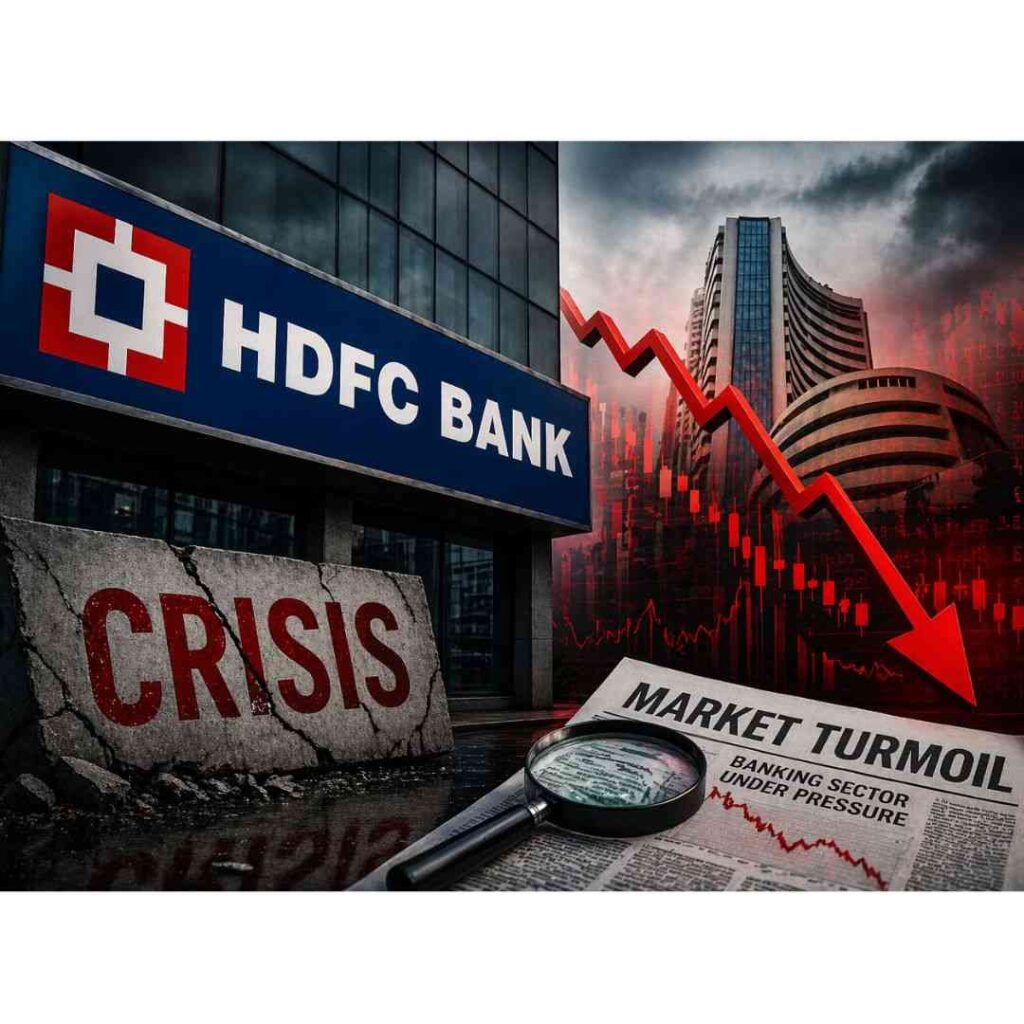
This case study examines the confluence of events that precipitated a crisis of confidence in HDFC Bank, India’s largest private sector lender, during the fiscal year 2025-2026. The bank experienced a 40% decline from its peak valuation, a ₹35,000 crore foreign institutional investor sell-off, and a governance crisis triggered by the abrupt resignation of its part-time chairman citing “ethical differences.” This article dissects the crisis through three analytical lenses: (1) the structural challenges arising from the 2023 merger with HDFC Ltd., including a loan-to-deposit ratio that surged to approximately 110%; (2) the governance rupture between Chairman Atanu Chakraborty and CEO Sashidhar Jagdishan, rooted in disagreements over accountability for Credit Suisse AT1 bond mis selling allegations and Dubai regulatory lapses; and (3) the divergent responses of foreign versus domestic institutional investors.
Introduction
HDFC Bank has long been regarded as the crown jewel of India’s banking sector. For over two decades, it delivered consistent return on equity, pristine asset quality, and compounded shareholder wealth at a rate that earned it a valuation premium over peers. As of October 2025, the bank’s shares touched an all-time high of ₹1,020.35, capitalizing at over ₹13.66 lakh crore (approximately $164 billion), making it one of the most valuable financial institutions in emerging markets.
Yet within six months, by March 30, 2026, the stock had cratered to a 52-week low of ₹726.65 a decline of more than 40% from its peak. The immediate trigger was a governance bombshell: the resignation of part-time chairman Atanu Chakraborty, who cited “certain happenings and practices within the bank” that were “not in congruence with his personal values and ethics”. The ensuing weeks saw a dramatic realignment of the shareholder base, with foreign institutional investors fleeing and domestic mutual funds aggressively accumulating.
This case study seeks to answer three central research questions:
- What structural vulnerabilities did the HDFC-HDFC Bank merger create, and how did these manifest in the bank’s loan-to-deposit ratio and net interest margin compression?
- What were the underlying drivers of the boardroom conflict between Chairman Chakraborty and CEO Jagdishan, and how did disagreements over accountability for the Credit Suisse AT1 bond episode and Dubai regulatory lapses catalyse the crisis?
- How did different investor classes—foreign institutional investors versus domestic mutual funds—interpret and respond to the governance signals, and what does this reveal about information asymmetry in emerging markets?
Merger
The Rationale for Merger
On April 4, 2022, HDFC Bank and Housing Development Finance Corporation (HDFC Ltd.) announced the largest merger in Indian corporate history. The all-stock transaction, valued at approximately $40 billion at announcement, created a financial behemoth with a combined balance sheet of over ₹28 lakh crore. The strategic logic was compelling:
Funding synergy: HDFC Ltd., as a housing finance company (NBFC), relied on wholesale borrowings and bank loans. Post-merger, it could access HDFC Bank’s low-cost current and savings account (CASA) deposits, potentially reducing its cost of funds by 150-200 basis points.
Cross-selling platform: The bank’s 6,000+ branches could distribute HDFC Ltd.’s mortgage products, while HDFC Ltd.’s customer base offered opportunities for cross-selling banking products.
Scale: The merged entity would become India’s second-largest bank by assets (after SBI) and the largest by market capitalization.
Integration Challenges
However, the merger also introduced significant complexities:
Asset-Liability Mismatch: HDFC Ltd.’s loan book consisted predominantly of long-duration mortgages (15-20-year tenors), funded by short-term borrowings (1-3 years). HDFC Bank’s traditional model matched retail deposits (3-5 years) with shorter-duration loans. Post-merger, this mismatch became a balance sheet feature, not a bug.
Priority Sector Lending (PSL) Compliance: As an NBFC, HDFC Ltd. was not subject to the same priority sector lending requirements as a bank. The RBI granted a staggered three-year transition period, allowing the merged entity to phase in one-third of HDFC Ltd.’s loan book for PSL calculation in Year 1, with full compliance by Year 3.
Regulatory Arbitrage Closure: HDFC Ltd. enjoyed certain flexibilities unavailable to banks, such as greater latitude in lending against shares. The RBI allowed existing loans against shares in HDFC Ltd.’s portfolio to continue until maturity but mandated that all retail and small business borrowers be transitioned to external benchmarks (repo rate) within six months of merger.
The Loan-to-Deposit Ratio Conundrum
The most visible metric of merger stress has been the loan-to-deposit ratio (LDR). Pre-merger, HDFC Bank maintained a conservative LDR in the mid-80s percentage range. Post-merger, this surged to approximately 110% as of Q2 FY2026, before moderating slightly.
Table 1: Evolution of HDFC Bank’s Loan-to-Deposit Ratio (2023-2026)
| Period | LDR (%) | Peer Comparison (ICICI Bank LDR) | Status |
| Pre-Merger (Q1 FY2023) | 86% | 84% | Healthy |
| Post-Merger (Q1 FY2024) | 108% | 83% | Elevated |
| Q2 FY2025 | 105% | 82% | Elevated |
| Q3 FY2025 | 102% | 81% | Improving |
| Q2 FY2026 | 99% | 80% | Elevated but trending down |
| Q3 FY2026 (Management Target) | 90-96% | — | Under guidance |
Sources: Company filings, DBS Research, Q3 Earnings Call
Management has committed to a “downward LDR glide path,” targeting 90-96% by end-FY2026 and potentially 85-90% by FY2027. However, achieving this requires deposit growth to meaningfully outpace loan growth, a challenge given systemic pressures on CASA ratios as customers shift to higher-yielding fixed deposits.
Net Interest Margin Compression
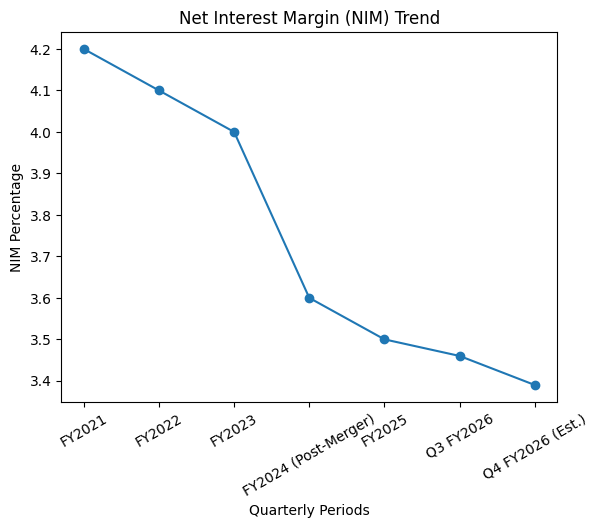
The LDR pressure has been accompanied by net interest margin (NIM) compression. Pre-merger, HDFC Bank consistently delivered NIMs around 4.1-4.3%. Post-merger, NIMs have slipped to approximately 3.35-3.46%
Chart 1: NIM Trajectory – Pre and Post Merger (2021-2026)
Source: Bloomberg estimates
The drivers of NIM compression are structural: (a) the merged entity must maintain higher liquidity buffers to manage the asset-liability mismatch, (b) deposit costs have risen as the bank competes for retail deposits to fund the merged loan book, and (c) the transition of HDFC Ltd.’s loan book to external benchmarks has repriced assets downward in a falling rate cycle.
Pre-Crisis Financial Health
Strong Underlying Performance
Despite headline stress, HDFC Bank’s core operating metrics remained resilient through the crisis period. The Q3 FY2026 earnings call (January 2026) revealed:
Asset quality described as “pristine” by management, with gross NPA accretion very low across portfolios
Slippages excluding agriculture in the mid-20 basis point range
Net credit costs (after recoveries) at approximately 37 basis points, broadly similar to historical levels
CEO Sashidhar Jagdishan characterized the banking industry as being in a “Cinderella phase,” with strong balance sheets and low NPA accretion system-wide.
Known Vulnerabilities
However, multiple stress points were evident well before the March 2026 governance crisis:
Regulatory Restrictions on Credit Cards: The RBI had previously imposed restrictions on HDFC Bank’s credit card customer acquisition following technology outages, a restriction that was only fully lifted after significant remediation.
Agricultural Portfolio Provisions: Following a regulatory inspection, the bank took approximately ₹500 crore of provisions related to agricultural loan compliance issues, which were “subsumed” in the December 2025 quarter results.
Dubai Branch Restrictions: HDFC Bank was barred from adding new customers at its Dubai branch after the Dubai International Financial Centre flagged lapses in client onboarding processes. The bank acknowledged “certain gaps” and completed remedial actions including personnel changes.
Q4 FY2026 Expectations
As of April 2026, analysts expected Q4 results (to be announced April 18, 2026) to show:
Table 2: Q4 FY2026 Consensus Estimates
| Metrics | Q4 FY2026 Estimate | YoY Change |
| Net Interest Income | ₹33,666 crore | +4.9% |
| Net Profit | ₹19,013 crore | +8.0% |
| Provisions | ₹3,448 crore | +7.9% |
| Net Interest Margin | 3.39% | -7 bps |
| Gross NPA Ratio | 1.2% | -4 bps (QoQ) |
Source: NDTV Profit / Bloomberg estimates
These estimates suggest that operational performance remained fundamentally sound, with the crisis driven primarily by governance perceptions rather than solvency concerns.
The Governance Crisis
On March 18, 2026, Atanu Chakraborty, part-time chairman and independent director of HDFC Bank, submitted his resignation with immediate effect. The letter, released to stock exchanges late that evening, contained an extraordinary passage:
“Certain happenings and practices within the bank that I have observed over last two years are not in congruence with my personal values and ethics”
The timing was devastating. The resignation came with no prior warning, no transition period, and no elaboration of the specific “happenings.” Board members, who had been summoned to a meeting on short notice, attempted to persuade Chakraborty to reconsider and to soften the language of his letter. He refused.
Subsequent reporting by Bloomberg and Reuters revealed a two-year pattern of escalating tension between Chakraborty and CEO Sashidhar Jagdishan. The fault lines were multiple:
Disagreement Over Accountability for Credit Suisse AT1 Bond Episode: Following the collapse of Credit Suisse in March 2023, Swiss regulators wrote down approximately $17 billion of Additional Tier 1 (AT1) bonds. HDFC Bank had distributed these bonds to wealthy clients, who subsequently alleged mis-selling claiming they were not adequately informed of the high-risk nature of the instruments.
While the matter led to sanctions against some executives, Chakraborty pushed for broader accountability, arguing that more senior officials should be held responsible. Management disagreed, creating an enduring impasse.
Dubai Regulatory Lapses: The Dubai International Financial Centre’s restrictions on HDFC Bank’s branch operations further strained relations. Chakraborty believed the response had been insufficient and that accountability should reach higher into the organization.
Strategic Disagreement Over MUFG Investment: A 2024 proposal for Mitsubishi UFJ Financial Group (MUFG) to invest in the bank’s consumer finance arm became a flashpoint. Jagdishan supported a foreign strategic partner; Chakraborty objected to foreign involvement and the lack of a competitive process. The plan ultimately fell apart.
Governance Style Clash: Chakraborty had developed a reputation for seeking more operational oversight than typical for a non-executive, part-time chairman. He was said to be closely involved in decisions such as extending senior employee tenures. This clashed with a management team shaped by former CEO Aditya Puri’s legacy of executive autonomy. Jagdishan, Puri’s successor, largely continued this approach. The resulting trust deficit proved unbridgeable.
Table 3: Timeline of Key Governance Events
| Date | Event |
| March 2023 | Credit Suisse collapse; AT1 bond write-down; HDFC Bank clients allege mis-selling |
| 2024 | MUFG investment proposal disagreement emerges |
| 2025 | Dubai branch restrictions imposed |
| March 18, 2026 | Chakraborty resigns with immediate effect, citing “ethical differences” |
| March 19, 2026 | Stock falls 8.7%; ₹1.35 lakh crore market cap erosion |
| March 20-25, 2026 | Board appoints Keki Mistry as interim chairman; external law firms appointed to review concerns |
| March 26, 2026 | Reports emerge that SEBI is reviewing resignation letter |
| April 8, 2026 | RBI Governor Sanjay Malhotra states no material governance concerns found |
Source: Business World, Money Control, Finimize
The Bank’s Defense
HDFC Bank’s board has consistently maintained that there are no governance or financial issues at the institution. Interim Chairman Keki Mistry, a veteran of India’s financial sector, stated on an analyst call that “relationship issues among employees are common in large organizations” and that the board had closed ranks behind management.
Theoretical Framework: The “Merged Entity Syndrome”
This case exhibits characteristics of what organizational theorists call “merged entity syndrome” a condition where post-merger integration pressures expose and exacerbate latent governance fault lines. In HDFC Bank’s case:
Role Ambiguity: The merger created a larger, more complex organization, but the boundary between board oversight and executive authority became contested. Chakraborty’s desire for more oversight collided with management’s preference for operational autonomy.
Cultural Clash: The legacy cultures of HDFC Bank (executive-led, autonomous) and HDFC Ltd. (more traditional, board-involved) never fully integrated at the board level.
Accountability Deficit: The Credit Suisse and Dubai episodes exposed ambiguities in who bears ultimate responsibility for regulatory compliance in a merged entity. Chakraborty’s push for senior-level accountability challenged management’s view that accountability should be delegated.
Market Reactions
The FII Exodus
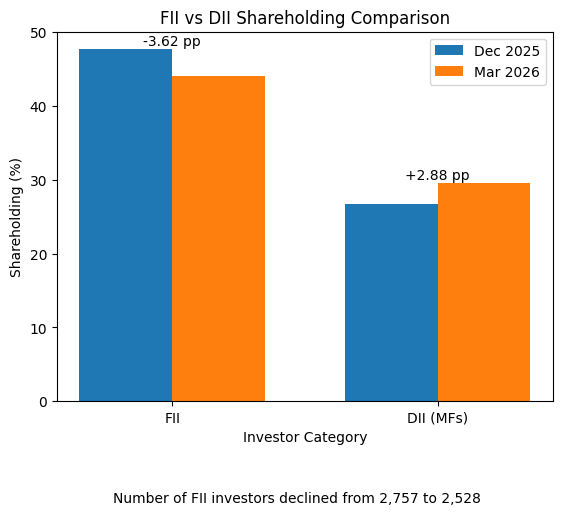
The most dramatic market reaction was the flight of foreign institutional investors. During the March 2026 quarter, FIIs offloaded shares worth approximately ₹35,000 crore, reducing their stake by 3.6 percentage points from 47.67% to 44.05%.
Chart 2: FII vs. DII Shareholding Trends (2025-2026)
Source: Businessworld
The FII exit was broad-based, involving 229 fewer FII investors at the end of March compared to December 2025. Global brokerage Jefferies went further, exiting its holdings in HDFC Bank entirely across multiple portfolios and removing it from key investment lists.
Domestic Institutional Buying
In stark contrast, domestic institutional investors particularly mutual funds stepped in as buyers of last resort. Mutual funds increased their holdings for the fifth consecutive quarter, reaching 29.54% from 26.66%.
Table 4: Major Domestic Buyers During March 2026 Correction
| Institution | Purchase Value (₹ crore) |
| ICICI Prudential Mutual Fund | 5,073 |
| SBI Mutual Fund | 2,706 |
| Nippon India Mutual Fund | 2,145 |
| Parag Parikh Flexi Cap Fund | — |
| UTI Mutual Fund | — |
| HDFC Mutual Fund | — |
| Total Mutual Fund Buying | 17,250 |
Source: Fortune India
By the end of March 2026, 49 mutual funds held 380.81 crore shares of HDFC Bank, valued at approximately ₹2.79 lakh crore. Overall DII ownership rose to approximately 40.3%, largely offsetting the FII selling.
Interpreting the Divergence
The FII-DII divergence can be understood through several lenses:
Information Asymmetry: Foreign investors, lacking the same access to management or on-the-ground intelligence, interpreted the governance signals more negatively. The vague but ominous resignation letter was particularly damaging for FIIs, who must justify holdings to global compliance committees.
Investment Mandates: Many foreign funds have governance screens that automatically trigger reviews following chairman resignations with ethical overtones. Domestic funds, particularly those with longer-term mandates and existing relationships with management, had greater flexibility to look through the noise.
Liquidity Dynamics: The FII exit created a price dislocation that domestic funds with mandates to deploy cash found attractive. The 17% decline in March alone offered a compelling entry point for value-oriented domestic investors.
RBI Assurance: The RBI’s statement that it had found “no material governance concerns” carried greater weight with domestic institutions, which operate under the central bank’s regulatory umbrella.
Market Capitalization Impact
The stock price decline translated into significant market capitalization erosion:
Table 5: Market Capitalization
| Date | Stock Price (₹) | Market Cap (₹ lakh crore) | Event |
| October 23, 2025 | 1,020.35 (peak) | 13.66 | All-time high |
| March 1, 2026 | 850 | 13.66 | Pre-crisis |
| March 19, 2026 | 775 | 12.31 | Post-resignation (8.7% drop) |
| March 30, 2026 | 726.65 (52-week low) | 12.61 | Peak panic |
| April 2026 | 756 | 12.85 | Partial recovery |
Note: Market cap figures approximate; Value on March 1, 2026. Source: Fortune India
The decline from peak to trough represented an erosion of approximately ₹1 lakh crore (about $12 billion) in shareholder wealth.
Implications for Corporate Governance in Indian Banking
The Part-Time Chairman Model Under Scrutiny
The HDFC Bank crisis raises fundamental questions about the part-time chairman model prevalent in Indian banking. Unlike the U.S. model, where the CEO and chairman roles are often separated with an independent lead director, many Indian banks have non-executive (part-time) chairmen who are expected to provide oversight without day-to-day involvement.
Chakraborty’s experience suggests that when a part-time chairman seeks more operational involvement as he did, according to insiders’ friction with management is almost inevitable. The lack of clear delineation between oversight and management in the merged entity created ambiguity that proved destabilizing.
Accountability in Merged Entities
The Credit Suisse AT1 bond episode highlights a broader challenge: in merged entities, how should accountability be assigned for legacy issues? The bonds were distributed pre-merger, but the merged entity inherited the liabilities. Management took “staff accountability actions through disciplinary and board-level committees”. Chakraborty wanted senior officials potentially including Jagdishan to be held responsible.
FII Vulnerability to Governance Shocks
The dramatic FII exodus underscores a vulnerability in India’s financial system: the dependence on foreign portfolio flows that can reverse abruptly in response to governance signals. While domestic institutions provided a buffer in this instance, the scale of FII selling ₹35,000 crore in a single quarter demonstrates the potential for governance events to trigger capital flow volatility.
Table 6: Comparative Governance Indicators – Indian Private Banks (2026)
| Bank | Chairman Status | CEO Tenure (years) | Recent Governance Event | FII Holding (%) |
| HDFC Bank | Interim (after resignation) | 5 | Chairman resignation over ethics | 44.05 |
| ICICI Bank | Stable | 6 | None | 48% |
| Kotak Mahindra Bank | Founder-led | 2 | None | 42% |
| Axis Bank | Stable | 4 | None | 55% |
Sources: Company filings, approximate
Conclusion
This case study has documented the confluence of three crises at HDFC Bank:
- A structural crisis arising from the 2023 merger with HDFC Ltd., manifested in an elevated loan-to-deposit ratio (peaking at 110%) and compressed net interest margins (340 basis points, down from 410 basis points pre-merger).
- A governance crisis triggered by Chairman Atanu Chakraborty’s resignation over “ethical differences,” rooted in two years of friction with CEO Sashidhar Jagdishan over accountability for Credit Suisse AT1 bond mis selling allegations, Dubai regulatory lapses, and strategic disagreements.
- A market crisis characterized by a ₹35,000 crore FII sell-off and a 40% decline from peak valuation, partially offset by aggressive domestic mutual fund buying of approximately ₹17,250 crore.
References
- BW Businessworld. (2026, April 5). FIIs Dump Rs 35,000 Cr Worth of HDFC Bank Shares in March Quarter Amid Governance Concerns.
- NDTV Profit. (2026, April 14). HDFC Bank Q4 Results Preview: Profit Seen Higher, NIMs To Stay Under Pressure.
- DBS Bank. (2026, March 23). HDFC Bank Ltd – Company Overview and Investment Thesis. Group Research – Equities.
- VC Circle (2026, April 3). Partial relief for HDFC Bank for meeting priority lending, CRR norms post-merger.
- Money control. (2026, March 27). HDFC Bank shares fall nearly 3% as SEBI likely reviewing ex-chairman’s exit letter, Jefferies exits lender.
- Yahoo Finance. (2026, January 18). HDFC Bank Q3 Earnings Call Highlights.
- Finimize (2026, March 29). HDFC Bank’s Governance Rift Spooked Investors and Sent Shares Sliding.
- Fortune India. (2026, April 14). Mutual funds pump ₹17,250 crore into HDFC Bank despite 17% March fall.
- Money control. (2026, April 8). RBI governor Sanjay Malhotra says no governance concern in HDFC Bank, says regulations ‘safe, resilient’.
- Money control / Bloomberg. (2026, March 23). Credit Suisse’s AT1 bond crash fuelled leadership crisis at HDFC.