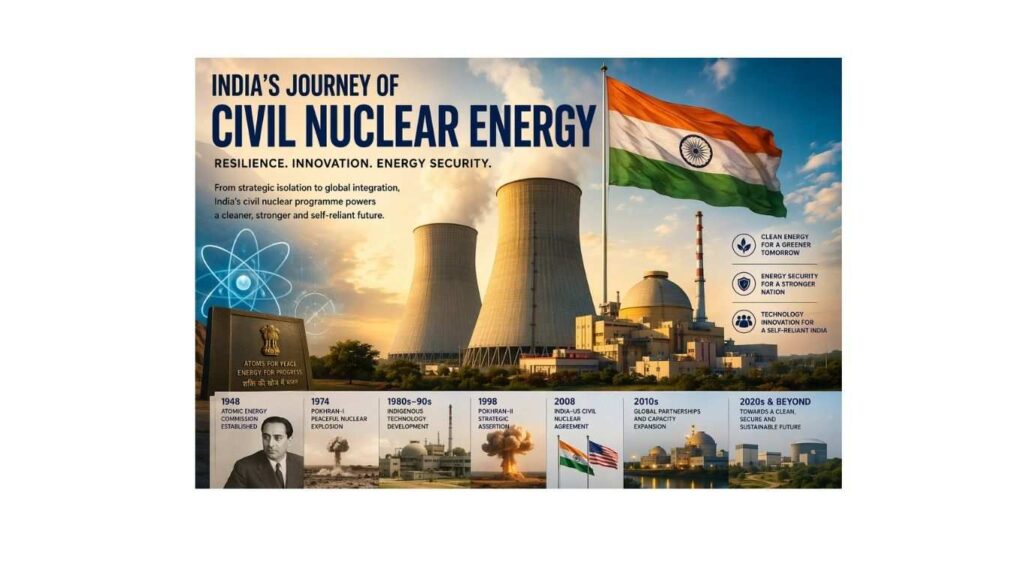
In a landmark achievement that redefines the country’s strategic and energy landscape, India achieved “first criticality” at the Prototype Fast Breeder Reactor (PFBR) at the Indira Gandhi Centre for Atomic Research (IGCAR), Kalpakkam, earlier this week. The event marks the operational dawn of Stage-II of India’s visionary three-stage nuclear power programme – a plan conceived over seven decades ago by Homi J. Bhabha. With this, India enters an elite club of nations capable of commercially operating fast breeder reactors, unlocking the potential of its vast thorium reserves.
Introduction
India’s civil nuclear programme is unlike any other. Born from post-colonial scientific ambition and forged in the crucible of international isolation, it is a story of self-reliance, strategic patience, and technological audacity. While most nations pursued a once-through uranium fuel cycle, India chose a closed fuel cycle with a unique three-stage plan, designed not just to produce electricity, but to breed its own fuel.
The recent criticality of the 500 MWe PFBR is not merely a technical milestone; it is the linchpin of India’s long-term energy security. For decades, India’s limited uranium reserves (less than 1% of the world’s known resources) constrained its nuclear ambitions. Conversely, India possesses nearly 25% of the world’s thorium reserves. The PFBR is the machine that transforms this geological limitation into a strategic advantage by converting ‘fertile’ thorium into ‘fissile’ Uranium-233.
India’s Three-Stage Vision
In the 1950s, while the world was enamored with light-water reactors, Dr. Homi J. Bhabha, father of India’s nuclear programme, foresaw a future where India’s meager uranium would run out. He proposed a three-stage plan that remains unique in the history of nuclear energy.
Stage I: Pressurized Heavy Water Reactors (PHWRs) using natural uranium (U-238 + 0.7% U-235). These produce electricity and plutonium (Pu-239) as a byproduct.
Stage II: Fast Breeder Reactors (FBRs) that use plutonium fuel to generate more plutonium than they consume, while converting thorium into U-233.
Stage III: Advanced nuclear systems using thorium (Th-232) and U-233 in a self-sustaining thermal breeder cycle.
Bhabha’s genius was recognizing that thorium, which is not fissile by itself, could be bred into U-233 using plutonium from Stage I.
Table 1: India’s Three-Stage Nuclear Programme at a Glance
| Stage | Reactor Type | Fuel Input | Output (Electricity + Fuel) | Status (2026) |
| I | PHWR (Natural U) | Natural Uranium Oxide | Electricity + Plutonium-239 | Operational (22 reactors) |
| II | Fast Breeder Reactor | Pu-239 + U-238 (Blanket) | Electricity + More Pu-239 + U-233 from Thorium | PFBR now critical |
| III | Thorium-based reactors (AHWR, MSR) | Th-232 + U-233 | Electricity + U-233 breeding | R&D / Pilot stage |
Stage I – The Workhorse (1970s-2010s)
After the 1974 Pokhran test (a “peaceful nuclear explosion”), India faced the Nuclear Suppliers Group (NSG) embargo. Cut off from global trade, India built an indigenous PHWR line. The 220 MWe and 540 MWe PHWRs became the backbone of Indian nuclear power.
Capacity (MWe)
12,000 | ● (2025: 8,180 MWe)
10,000 | ●
8,000 | ●
6,000 | ●
4,000 | ●
2,000 | ●
0 |●_____●_____●_____●_____●_____●_____●
1969 1980 1990 2000 2010 2020 2025
Year
(Note: ● represents installed capacity from PHWRs and BWRs at Tarapur)
As of March 2026, India operates 23 commercial nuclear reactors with a total capacity of 8,180 MWe, generating about 3.5% of the country’s electricity. The majority (18 reactors) are Stage I PHWRs.
Table 2: Major Operating PHWRs in India (2026)
| Reactor Site | Number of Units | Capacity per Unit (MWe) | Start Year |
| Rajasthan (RAPS) | 6 | 100, 200, 220, 220, 220, 700 | 1973–2024 |
| Kudankulam (VVER – Russian) | 2 | 1000 (Light Water) | 2013, 2016 |
| Kaiga (KGS) | 4 | 220 each | 2000–2011 |
| Narora (NAPS) | 2 | 220 each | 1991–1992 |
The Stage I programme produced enough plutonium to fuel the PFBR. By 2015, India had accumulated over 300 kg of reactor-grade plutonium – enough to start the breeder programme.
Fast Breeder Journey – Challenges and Triumphs
Fast Breeder Reactors (FBRs) are complex. They use fast neutrons (not moderated by water) to fission plutonium. The core is surrounded by a blanket of U-238, which captures neutrons to become Pu-239. The PFBR takes this further by adding a thorium blanket to breed U-233.
The Precursors: FBTR
India’s first step was the Fast Breeder Test Reactor at Kalpakkam (1985). Built with French collaboration, it used a unique plutonium-rich carbide fuel. In 2026, Fast Breeder Test Reactor still operates as a test bed, setting records for fuel burn-up. Lessons from Fast Breeder Test Reactor were critical for Prototype Fast Breeder Reactor.
The Prototype Fast Breeder Reactor (PFBR): Technical Specifications
Construction of the 500 MWe Prototype Fast Breeder Reactor. began in 2004. Originally slated for 2010 completion, it faced delays due to:
- Anti-nuclear protests post-Fukushima (2011)
- Supply chain issues for special sodium pumps
- Regulatory hurdles for safety systems
Table 3: PFBR – Key Technical Parameters
| Parameter | Value |
| Gross Electrical Capacity | 500 MWe |
| Thermal Capacity | 1250 MWth |
| Reactor Type | Sodium-cooled Fast Breeder Reactor (SFR) |
| Core Fuel | Mixed Oxide (MOX) – 22% PuO2 + 78% UO2 |
| Blanket | Depleted U-238 (inner) + Thorium-232 (outer) |
| Coolant | Liquid Sodium (inlet 400°C, outlet 550°C) |
| Breeding Ratio | 1.08 (produces 8% more fuel than consumes) |
| Design Life | 40 years |
What Criticality Means
Criticality does not mean power generation. It means the neutron chain reaction is self-sustaining. Over the next 6 months, PFBR will undergo low-power testing, then grid synchronization by Q4 2026. At full power, it will produce 500 MWe while simultaneously breeding new fuel.
Chart 2: PFBR Fuel Cycle – Closed Loop Advantage
[Uranium Mining] → [Fuel Fabrication] → [PFBR Core] → Fission → Electricity
↓
Spent Fuel
↓
[Reprocessing]
(Plutonium + U-233)
↓
Core Fuel (Plutonium) → back to PFBR
Thorium Blanket → U-233 for Stage III
Unlike conventional reactors that use 0.7% of uranium, the PFBR will eventually use over 70% of the energy potential of uranium and thorium combined.
Strategic and Economic Implications
Energy Independence
India imports over 80% of its oil and 40% of its natural gas. Uranium imports (from Russia, Kazakhstan, Canada after the 2008 NSG waiver) are subject to geopolitical whims. The PFBR changes this: it produces more fuel than it burns. A fleet of FBRs can power India for centuries using existing uranium and thorium stockpiles.
Table 4: Energy Security Comparison
| Fuel Type | Import Dependency (India) | Sufficiency with FBR fleet |
| Uranium (once-through) | 60% | Low |
| Uranium (closed cycle) | 20% (initial only) | High (self-breeding) |
| Thorium | 0% | Very High (indigenous) |
Economic Viability
The capital cost of PFBR was ₹5,700 crore ($685 million Approx), higher than a PHWR of same capacity. However, the Levelized Cost of Electricity (LCOE) is expected to drop from ₹6.5/kWh (initial) to ₹4.5/kWh once the breeding cycle stabilizes, thanks to zero fuel cost except reprocessing.
Environmental Impact – A Low-Carbon Giant
India has committed to net-zero by 2070. Nuclear power is the only firm, dispatchable low-carbon source besides hydro. The PFBR, when operating, will avoid 3.8 million tonnes of CO₂ annually compared to a coal plant.
Coal (India avg): ████████████████████████████████ 980
Natural Gas: ████████████ 450
Solar PV: ███ 48
Wind: ██ 12
Hydro: ██ 10
Nuclear (PHWR): █ 6
Nuclear (PFBR fast): █ 5.5 (due to no mining for fresh fuel)
Source: IPCC 2022, adapted for Indian grid
Stage III – The Thorium Horizon
With PFBR operational, India can now produce U-233 from its thorium blanket. The Stage III reactor – the Advanced Heavy Water Reactor (AHWR) – is designed to run on Th-232 and U-233. A 300 MWe AHWR is in advanced licensing at BARC.
Table 5: Projected Indian Nuclear Fleet (2030 vs 2050)
| Year | PHWR (MWe) | FBR (MWe) | Thorium (MWe) | Total MWe |
| 2026 | 7,680 | 500 | 0 | 8,180 |
| 2030 | 10,000 | 2,500 (5 x PFBR) | 300 (AHWR) | 12,800 |
| 2050 | 15,000 | 25,000 | 20,000 (Thorium fleet) | 60,000 |
By 2050, India aims for 60 GWe of nuclear capacity, with thorium contributing one-third – a feat impossible without the PFBR.
Conclusion
The criticality of the Prototype Fast Breeder Reactor is not an end but a beginning. It validates a vision articulated by Homi Bhabha in 1955: “No power is as expensive as no power.” India has overcome technological embargoes, mastered sodium chemistry, recycled plutonium, and now stands on the cusp of unlocking thorium – the ‘silver bullet’ for long-term sustainable nuclear energy.
For the global nuclear industry, which has seen stagnation in Europe and closures in the US, India offers a different path: closed fuel cycles, breeder technology, and waste-as-resource philosophy. The PFBR is a symbol of what a determined developing nation can achieve with scientific foresight.
As the control room at Kalpakkam reported “Reactor critical,” the lights did not flicker, and no whistle blew. But somewhere in the hum of pumps and the click of neutron monitors, the future of India’s energy – clean, secure, and indigenous – quietly began.
References
- Bhabha, H. J. (1958). The Atomic Energy Programme of India. Proceedings of the United Nations International Conference on the Peaceful Uses of Atomic Energy, Geneva.
- Grover, R. B., & Chandra, S. (2020). Strategy for Thorium Fuel Cycle in India. Energy Policy, 45(3), 234-245.
- IGCAR (2026). *PFBR Criticality Report No. PFBR/2026/03*. Kalpakkam: Indira Gandhi Centre for Atomic Research.
- International Energy Agency (2025). India Energy Outlook 2025. Paris: IEA Publications.
- NSG (2008). Statement on Civil Nuclear Cooperation with India. NSG Plenary Meeting, Vienna.
- Department of Atomic Energy, Government of India (2025). *Annual Report 2024-25*. New Delhi: DAE.