What SEBI’s AI Push Means for India’s Stock Market?

India’s securities-market regulator is exploring two significant artificial intelligence initiatives: a controlled AI sandbox and a domestically governed AI model designed specifically for the securities market. SEBI Chairman Tuhin Kanta Pandey outlined these proposals at the Dhanam BFSI Summit in Kochi on 25 November 2026. The announcement comes as the regulator is already using AI to review financial advertisements and identify potentially misleading market-related content online. For investors, brokers and financial institutions, the proposals raise an important question: can artificial intelligence improve market supervision without compromising investor protection, data security and accountability?
Key takeaways
- SEBI is exploring an AI sandbox and a domestically governed AI model for securities markets.
- The regulator already uses AI tools, including R(AI)DAR and Sudarshan, for supervisory activities.
- The proposed initiatives could improve market surveillance, compliance and investor protection.
- Data confidentiality, cybersecurity, algorithmic bias and human accountability remain significant concerns.
- Neither the proposed domestic model nor the AI sandbox should be treated as an already launched public service.
What exactly has SEBI announced about artificial intelligence?
At the 25 November summit, SEBI outlined four priorities for the next phase of financial-market development. One of them was responsible technological innovation.
The regulator said it was exploring an AI sandbox to test applications in a controlled environment. It was also examining a domestically governed AI model specifically for the securities market.
The objective is to make secure and affordable AI tools more widely accessible while improving the technological capabilities of India’s financial ecosystem.
These are important developments, but their status needs to be understood correctly.
SEBI has announced that it is exploring these possibilities. The announcement does not establish that the sandbox is operational, that a domestic model is ready, or that market participants can already access either facility.
What is an AI sandbox?
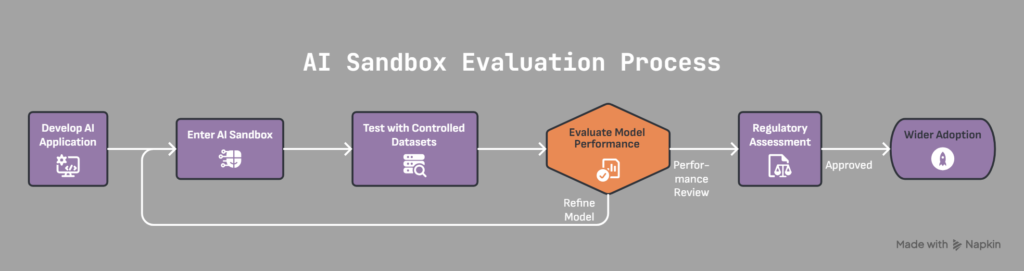
An AI sandbox is a controlled testing environment where developers and institutions can evaluate new technology without immediately exposing live financial systems or investors to its consequences.
Imagine a brokerage firm developing an AI application to identify suspicious trading patterns.
Before using it across its operations, the firm could potentially test the system using controlled datasets and simulated scenarios. It could examine whether the model identifies suspicious activity correctly, produces false alerts or misses important patterns.
A regulatory sandbox can help evaluate such applications under defined safeguards.
For SEBI, this could provide a structured environment for assessing financial-sector AI applications before wider adoption.
However, the specific eligibility conditions, testing arrangements, data access rules and operational timelines for the proposed SEBI AI sandbox have not been established in the public announcement.
Why does SEBI want a domestically governed AI model?
Financial institutions increasingly depend on technology providers to process confidential information, analyse customer behaviour and support business decisions.
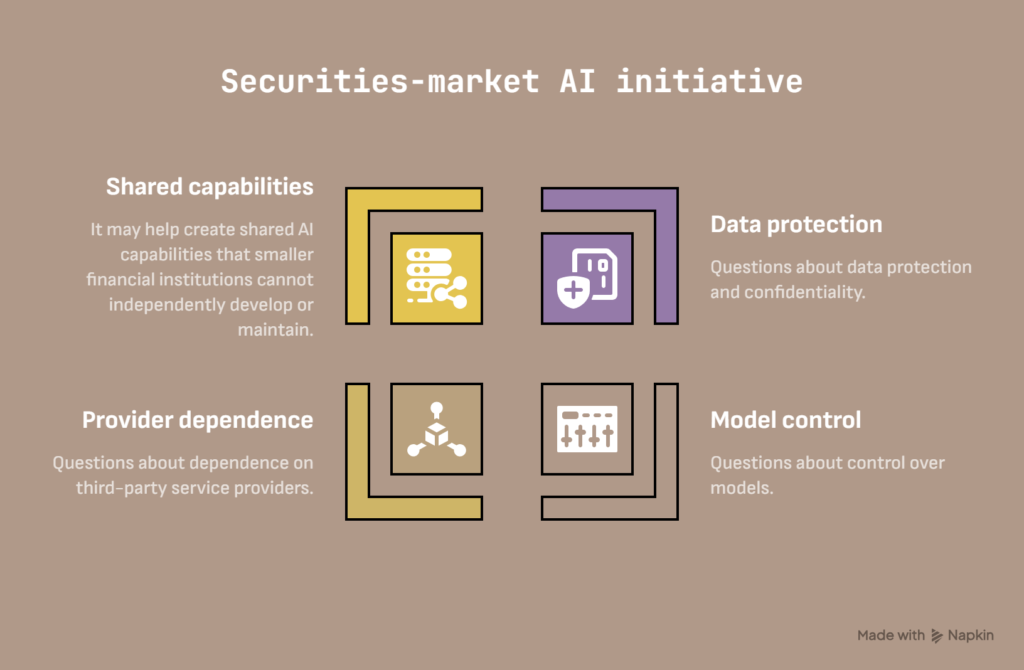
Using externally hosted AI systems can raise questions about data protection, confidentiality, control over models and dependence on third-party service providers.
A domestically governed securities-market AI model could potentially address some of these concerns.
It may also help create shared AI capabilities that smaller financial institutions cannot independently develop or maintain.
This does not necessarily mean that SEBI intends to build an AI chatbot for investors or a system that recommends which shares to purchase. The announcement describes a securities-market-specific AI initiative, not an individual stock-picking service.
Its eventual architecture, training data, intended users and applications remain to be clarified.
SEBI is already using AI to monitor India’s financial markets
The November announcement is not the regulator’s first move towards artificial intelligence.
SEBI has already deployed AI-assisted tools to strengthen supervision and identify potential violations.
Two notable examples are:
| AI tool | Purpose |
| R(AI)DAR | Reviews financial advertisements for regulatory compliance |
| Sudarshan | Identifies potentially misleading market-related content on social media |
| Additional tools under development | Analyse compliance reports and identify potential risks earlier |
These applications address a growing challenge for the securities market.
Investors increasingly receive financial information through social media, online advertisements, messaging platforms and digital investment communities.
Not all such information is reliable. Misleading financial promotions, impersonation of registered investment professionals and fraudulent investment claims can expose inexperienced investors to losses.
AI can help regulators process large volumes of information and identify suspicious patterns more efficiently than manual monitoring alone.
SEBI has also made an important distinction between identifying a potential violation and establishing that a violation actually occurred. An automated alert still requires appropriate human assessment.
How AI could change the way India’s securities market operates?
The most significant impact may extend beyond SEBI’s own supervisory operations.
If the proposed AI initiatives progress, they could influence several parts of the financial-market ecosystem.
1. Better detection of market manipulation
Stock exchanges and regulators process enormous amounts of trading information.
AI systems can examine transaction patterns, price movements, trading volumes and relationships between market participants to identify activity that deserves closer investigation.
For example, an AI-assisted surveillance system could identify unusual trading patterns across several securities and generate alerts for investigators.
This would not automatically establish manipulation. It would help regulators prioritise areas requiring investigation.
2. Improved compliance for brokers and intermediaries
Financial institutions operate under extensive regulatory requirements.
AI could help institutions examine transaction records, review disclosures, identify missing documentation and monitor potential compliance risks.
This may reduce repetitive manual work, particularly for organisations processing large volumes of customer and transaction information.
Smaller institutions could benefit from affordable shared technology, provided appropriate access and security arrangements are established.
3. Stronger protection against investment fraud
Fraudsters frequently exploit social media platforms to impersonate registered professionals and promote misleading investment opportunities.
AI-assisted systems can examine advertisements, text patterns, accounts and digital activity to identify suspicious content.
Earlier detection could help regulators and platforms respond more quickly.
However, technology alone cannot prevent every fraudulent activity. Scammers continually change their methods, while automated systems can also mistakenly flag legitimate content.
4. More efficient financial services
AI applications could improve customer support, document processing and risk assessment across financial institutions.
For retail investors, better technology could eventually mean faster customer service and more efficient financial-market operations.
The actual benefits will depend on implementation, data quality and the ability of institutions to manage technology risks.
Responsible AI will be just as important as innovation
The expansion of artificial intelligence creates risks that cannot be ignored.
In June 2025, SEBI published a consultation paper outlining proposed guiding principles for responsible AI and machine-learning applications in securities markets.
The document identified five broad areas:
- Model governance.
- Investor protection and disclosure.
- Testing frameworks.
- Fairness and bias.
- Data privacy and cybersecurity.
The working group’s recommendations also emphasised continuous monitoring, appropriate safeguards and human oversight throughout the AI development and deployment lifecycle.
These principles are particularly relevant when AI systems influence investment-related decisions or regulatory supervision. The consultation document should not be confused with proof that every proposed principle has become a binding regulation.
The problem of incorrect AI decisions
AI models can produce inaccurate conclusions.
A surveillance system may incorrectly identify legitimate trading as suspicious. A financial-advertisement review tool may miss misleading claims or flag compliant advertisements.
In more sophisticated systems, including generative AI, incorrect information may appear convincing.
This makes human supervision essential.
An AI-generated alert should guide an investigation, not automatically determine guilt, impose penalties or establish financial wrongdoing.
Data security and third-party dependence
Financial institutions process sensitive customer information and commercially confidential data.
Poorly controlled AI systems could expose this information through inadequate access controls, insecure integrations or third-party technology providers.
There is also the issue of technology concentration. If several major financial institutions depend on a small number of AI service providers, an outage or security failure could have wider consequences.
SEBI’s emphasis on cybersecurity and institutional accountability therefore forms an important part of its proposed AI direction.
How international regulators are approaching AI?
India’s developments are part of a wider transformation in financial-market regulation.
In October 2026, the International Organization of Securities Commissions (IOSCO) published its final supervisory toolkit for AI use in capital markets.
The toolkit provides practical, non-binding guidance to securities regulators on supervising AI systems used by financial institutions.
It covers governance and risk management, third-party dependencies, disclosure, record-keeping and reporting.
The document also highlights risks associated with generative AI, including hallucinations, limited transparency and increased complexity.
SEBI’s efforts to develop its own AI capabilities can therefore be viewed against a broader international move towards technology-assisted supervision and stronger AI governance.
The important distinction is that international supervisory guidance does not automatically become Indian regulatory law.
What this means for retail investors?
For ordinary investors, the immediate impact is unlikely to be a new AI-powered investment product.
The more relevant development is the possibility of stronger supervision of financial intermediaries and digital investment activity.
Over time, improvements in market surveillance and fraud detection could help create a more transparent investment environment.
Investors should nevertheless understand three things.
First, an AI-generated investment recommendation is not necessarily reliable just because it comes from a sophisticated model.
Second, automated fraud detection cannot eliminate investment scams. Investors should continue to verify financial professionals and intermediaries through SEBI’s official resources.
Third, increased use of AI does not remove responsibility from brokers, investment advisers or other regulated institutions.
The regulatory direction suggests that accountability must remain with the institutions using these technologies.
What should investors and financial institutions watch next?
The next important developments will be the practical details of SEBI’s proposals.
Market participants should watch for information about the proposed sandbox’s scope, eligibility, testing procedures and safeguards.
The development of a domestic AI model will also require clarity about its intended applications, data governance, access framework and accountability arrangements.
For financial institutions, the broader message is that adopting AI without appropriate controls may create as many risks as it solves.
The competitive advantage will increasingly come from using AI responsibly, not simply using it more extensively.
Conclusion
SEBI’s AI initiatives could represent an important step in modernising India’s securities-market supervision. The proposed AI sandbox and domestically governed model offer opportunities to improve monitoring, compliance and investor protection, but their success will depend on reliable data, cybersecurity and clear accountability.
The next development to watch is not simply whether SEBI builds an AI model, but how it establishes safeguards for the institutions and investors expected to use these technologies.
References:
- Reuters — India’s markets regulator weighs domestic AI model for securities trading, 28 October 2026.
- The Economic Times — SEBI exploring AI sandbox and domestically governed AI model, 25 November 2026.
- Business Standard — SEBI explores India-specific AI model for securities-market oversight, October 2026.