
The India–European Union Free Trade Agreement (FTA), concluded in 2026, constitutes one of the most comprehensive bilateral trade accords of the contemporary global economy. Encompassing goods, services, investment, sustainability, digital trade, and labour standards, the agreement establishes one of the world’s largest free trade areas. This article evaluates the economic rationale, trade dynamics, sectoral implications, and geopolitical significance of the agreement. Using recent trade data and policy analysis, it argues that the India-EU FTA represents a strategic reorientation in global economic governance, with far-reaching implications for supply-chain resilience, sustainable development, and the evolution of international trade norms.
Introduction
After nearly two decades of negotiations, India and the European Union concluded a landmark Free Trade Agreement in January 2026. The agreement establishes a free trade area covering nearly two billion people and more than one-fourth of global gross domestic product (GDP), positioning it among the most consequential trade arrangements of the 21st century. Beyond its commercial scope, the Free Trade Agreement reflects a strategic convergence between the world’s largest democracy and its most integrated economic bloc, occurring at a time of heightened geopolitical rivalry, trade fragmentation, and supply-chain reconfiguration.
This article examines the India-EU FTA from four analytical perspectives: (i) its economic foundations and trade performance prior to the agreement; (ii) the scope and depth of market access commitments across goods, services, and investment; (iii) sectoral impacts and domestic adjustment dynamics; and (iv) the agreement’s broader implications for global trade governance and international political economy.
Trade Relations Prior to the Agreement
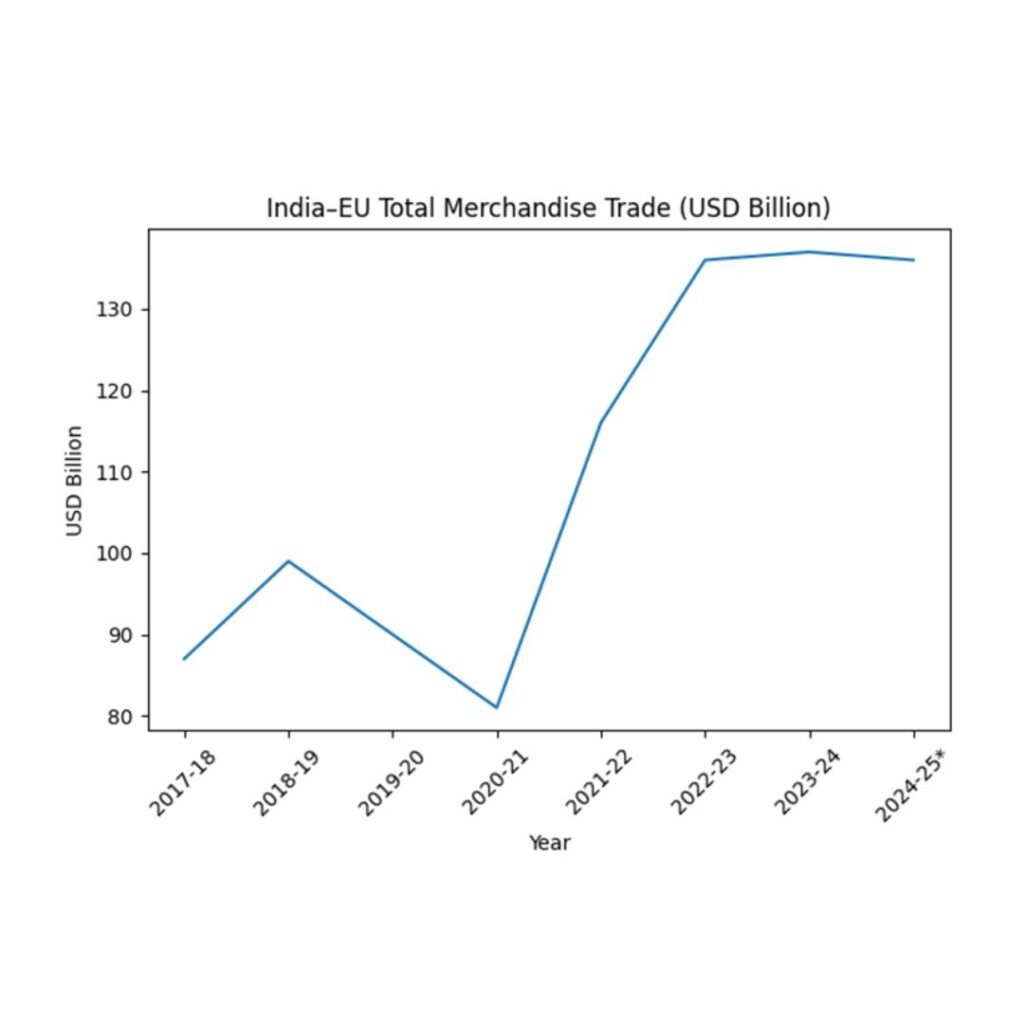
India and the EU have historically maintained robust economic relations. The EU has consistently ranked among India’s top three trading partners, while India is one of the fastest-growing major markets for European exports and investment. Merchandise trade expanded from approximately USD 87 billion in 2017–18 to over USD 137 billion in 2023-24, despite a temporary contraction during the COVID-19 pandemic.
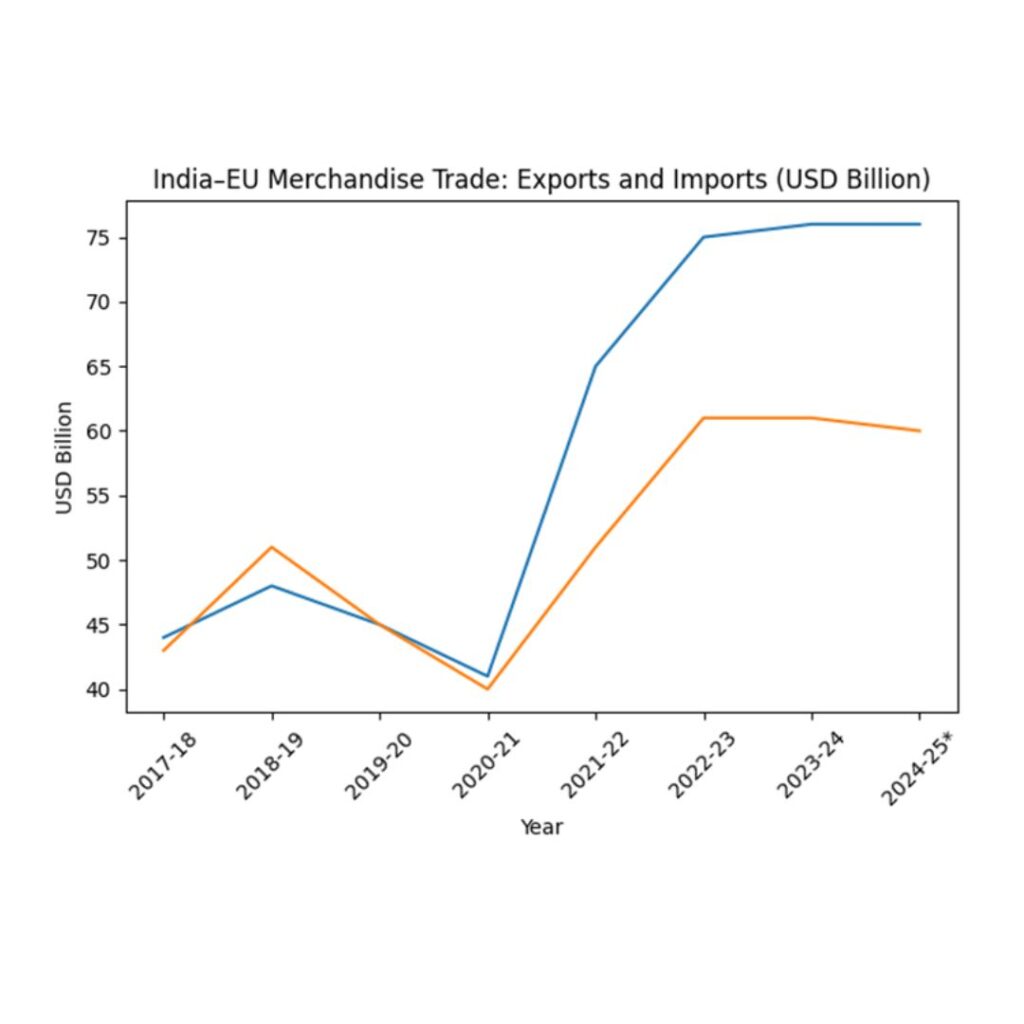
India’s exports to the EU increased from roughly USD 44 billion in 2017-18 to over USD 76 billion in 2023-24, while imports from the EU rose from about USD 43 billion to approximately USD 61 billion over the same period. These trends reflect structural complementarities between the two economies: India’s comparative advantage in labor-intensive manufacturing, pharmaceuticals, and services intersects with the EU’s strengths in high-technology manufacturing, capital goods, green technologies, and high-value services.
Table 1 presents recent India-EU merchandise trade flows, while Figures 1 and 2 illustrate export-import dynamics and total trade trends over time.
Table 1: India–EU Merchandise Trade (USD Billion)
| Year | Exports | Imports | Total Trade |
| 2017-18 | 44 | 43 | 87 |
| 2018-19 | 48 | 51 | 99 |
| 2019-20 | 45 | 45 | 90 |
| 2020-21 | 41 | 40 | 81 |
| 2021-22 | 65 | 51 | 116 |
| 2022-23 | 75 | 61 | 136 |
| 2023-24 | 76 | 61 | 137 |
| 2024-25* | 76 | 60 | 136 |
Market Access and Tariff Liberalization
The core of the FTA lies in its tariff liberalization commitments. The EU has agreed to eliminate duties on nearly 95 percent of tariff lines for Indian exports over phased transition periods, covering more than 90 percent of the value of bilateral trade. Key beneficiary sectors include textiles and apparel, leather and footwear, marine products, gems and jewellery, pharmaceuticals, chemicals, engineering goods, and automotive components.
India, in turn, has committed to reducing or eliminating tariffs on over 90 percent of EU exports, including industrial machinery, medical devices, chemicals, renewable energy technologies, automobiles, and high-end consumer goods. Sensitive sectors, particularly automobiles and select agricultural products, are subject to extended transition periods, tariff rate quotas, and safeguard mechanisms to mitigate domestic adjustment costs.
These tariff reductions are expected to enhance price competitiveness, expand trade volumes, and deepen integration into global value chains, particularly for manufacturing-intensive sectors aligned with India’s industrial policy objectives.
Services Trade and Regulatory Cooperation
Services constitute a central pillar of the India-EU Free Trade Agreement. Services account for more than 50 percent of India’s GDP and over 70 percent of the EU’s economic output, yet they have historically faced significant regulatory barriers. The agreement expands market access across a wide range of service sectors, including information technology, financial services, professional services, education, engineering, construction, telecommunications, and digital services.
Importantly, the agreement incorporates regulatory cooperation mechanisms, transparency commitments, and mutual recognition frameworks aimed at reducing behind-the-border barriers. These provisions are expected to facilitate cross-border service provision, enhance regulatory predictability, and lower transaction costs for service suppliers on both sides.
For Indian IT and business process outsourcing firms, the agreement strengthens legal certainty regarding data flows, market access, and professional recognition in EU markets. For European financial institutions and professional service providers, it enhances access to India’s rapidly expanding services ecosystem.
Mobility and Human Capital Integration
The FTA includes substantive commitments on the temporary movement of natural persons, encompassing intra-corporate transferees, independent professionals, contractual service suppliers, and business visitors. These provisions address skills shortages in key sectors such as engineering, healthcare, digital technology, and advanced manufacturing, while strengthening people-to-people ties and academic collaboration.
The emphasis on mobility reflects a broader recognition that human capital, rather than goods alone, constitutes a primary driver of contemporary economic integration. By embedding labour mobility within a trade framework, the agreement advances a more holistic model of economic partnership.
Investment Protection and Legal Certainty
Investment constitutes another cornerstone of the agreement. The European Union is among the largest sources of foreign direct investment (FDI) into India, with cumulative investments exceeding USD 100 billion, while Indian firms have increasingly invested in EU markets, particularly in information technology, pharmaceuticals, automotive manufacturing, and renewable energy.
The agreement establishes a modern investment protection framework that balances investor rights with host-state regulatory autonomy. It includes transparent dispute settlement mechanisms, safeguards against arbitrary or discriminatory treatment, and commitments to fair and equitable treatment. These provisions aim to reduce investor risk, enhance regulatory predictability, and stimulate long-term capital flows.
Sustainability, Climate Governance, and Labour Standards
The India-EU FTA is distinguished by its strong sustainability architecture. It includes binding chapters on environmental protection, climate change mitigation, labor rights, corporate social responsibility, and inclusive growth. The agreement aligns with the Paris Agreement and supports cooperation in renewable energy, green hydrogen, carbon markets, and sustainable finance.
However, these commitments also introduce new compliance requirements, particularly for exporters in carbon-intensive industries. Measures such as the European Union’s Carbon Border Adjustment Mechanism (CBAM) necessitate investments in cleaner production technologies, emissions monitoring, and sustainability reporting. While these requirements impose short-term adjustment costs, they also strengthen long-term competitiveness and align trade with climate objectives.
Sectoral Impacts
Textiles and Apparel
India’s textile and apparel sector is among the principal beneficiaries of the FTA. The elimination of tariffs, previously ranging between 8 and 12 percent, significantly enhances price competitiveness in EU markets. Given the sector’s labour-intensive nature, these gains are expected to translate into substantial employment generation, particularly within MSME clusters.
Pharmaceuticals and Chemicals
India’s pharmaceutical exports to the EU already exceed USD 7 billion annually. The FTA strengthens regulatory cooperation, streamlines approval processes, and enhances intellectual property protection, facilitating faster market entry for Indian generics, biosimilars, and specialty pharmaceuticals. The chemical sector, including specialty chemicals and agrochemicals, similarly benefits from tariff elimination and technical standard harmonization.
Engineering Goods and Machinery
Engineering goods constitute one of India’s largest export categories to Europe. Tariff liberalization and regulatory alignment are expected to expand exports of industrial machinery, auto components, electrical equipment, and precision instruments. Concurrently, European manufacturers gain enhanced access to India’s infrastructure, manufacturing, and industrial modernization initiatives.
Automobiles and Auto Components
The automobile sector represents a sensitive domain. India’s phased tariff reductions on high-end automobiles and components are balanced by long transition periods and safeguard clauses. For European automakers, the agreement unlocks access to a rapidly expanding market; for Indian manufacturers, increased competition is expected to catalyze technological upgrading, productivity gains, and integration into global automotive value chains.
Agriculture and Food Products
Agriculture posed significant political sensitivity during negotiations. The agreement provides market access for select European products such as wines, spirits, dairy, and processed foods, while safeguarding India’s core agricultural interests through tariff rate quotas and safeguard mechanisms. Indian exports of marine products, spices, tea, coffee, rice, and organic foods benefit from preferential access to European Union markets.
Strategic and Geopolitical Implications
The India-EU FTA must be situated within the broader context of global geopolitical realignment. As trade becomes increasingly fragmented and supply chains are restructured to mitigate geopolitical risk, both India and the EU are pursuing diversification strategies that reduce dependence on politically volatile regions.
For India, the agreement strengthens integration with Western-led economic frameworks while preserving strategic autonomy. It complements India’s trade engagements with the United Kingdom, Australia, the United Arab Emirates, and other partners, positioning India as a central node within diversified global supply chains.
For the EU, the agreement reinforces its Indo-Pacific strategy, supports its green and digital transitions, and reduces economic over-reliance on any single partner. It also aligns with the EU’s broader objective of promoting high-standard trade agreements grounded in sustainability, labour rights, and regulatory transparency.
Challenges and Implementation Risks
Despite its comprehensive scope, the FTA faces several implementation challenges. First, non-tariff barriers, including technical standards, conformity assessments, and regulatory compliance costs, may constrain effective market access, particularly for MSMEs. Second, the ratification process within the European Union requiring approval by the European Parliament and national legislatures may introduce delays or political scrutiny. Third, domestic adjustment pressures in sensitive sectors necessitate targeted policy interventions, including skilling, re-skilling, industrial upgrading, and social protection measures.
Furthermore, sustainability compliance requirements, while normatively desirable, impose additional costs on exporters and necessitate investments in green technologies and reporting systems. Failure to address these challenges could limit utilization rates and dampen the agreement’s economic impact.
Policy Implications and Recommendations
To maximize the benefits of the FTA, India must pursue a complementary domestic reform agenda. This includes strengthening export facilitation infrastructure, modernizing ports and logistics networks, enhancing standards and quality infrastructure, and aligning skill development with international market requirements.
Equally important is sustained regulatory dialogue with EU counterparts on digital trade, data governance, sustainability standards, and professional qualifications. Such engagement is essential for reducing behind-the-border barriers and ensuring dynamic regulatory convergence.
At the institutional level, effective monitoring, dispute resolution, and stakeholder consultation mechanisms will be critical to maintaining confidence in the agreement and ensuring its adaptive evolution.
Implications for Global Trade Governance
The India–EU FTA carries significant implications for global trade governance. In an era marked by stagnation in multilateral trade negotiations, bilateral and regional agreements increasingly shape the rules of international commerce. This agreement sets new benchmarks in digital trade, sustainability, labour standards, and investment protection, demonstrating the feasibility of high-standard trade agreements even amid geopolitical fragmentation.
Moreover, the agreement exemplifies a model of trade governance that integrates economic, environmental, and social objectives, a paradigm increasingly necessary for addressing global challenges such as climate change, inequality, and technological disruption.
Conclusion
The India–European Union Free Trade Agreement of 2026 constitutes a defining development in contemporary international political economy. By establishing one of the world’s largest and most comprehensive free trade areas, it enhances economic integration, strengthens supply-chain resilience, and advances sustainable development objectives.
The agreement reflects a convergence of economic pragmatism and strategic vision. It underscores the recognition that, in an era of geopolitical uncertainty, durable economic partnerships grounded in transparency, regulatory cooperation, and shared normative commitments are essential for long-term stability and prosperity.
Ultimately, the success of the agreement will depend on effective implementation, domestic reform, and institutional capacity-building. If these conditions are met, the India-EU Free Trade Agreement has the potential not only to transform bilateral trade relations but also to contribute meaningfully to the evolution of global trade governance in the 21st century.
References
1. European Commission. “EU-India Free Trade Agreement: Chapter-by-Chapter Summary.” Brussels, 2026. https://ec.europa.eu
2. Government of India, Ministry of Commerce and Industry. Export-Import Data Bank, 2017–2025. https://commerce.gov.in
3. Reuters. “India and EU Conclude Landmark Trade Deal.” January 2026. https://www.reuters.com
4. Financial Times. “EU and India Seal Trade Pact to Slash Tariffs.” 2026. https://www.ft.com
5. World Trade Organization. World Trade Statistical Review. https://www.wto.org
6. European Parliament. “Impact Assessment of the EU–India Free Trade Agreement.” 2026. https://www.europarl.europa.eu
7. UN Conference on Trade and Development (UNCTAD). World Investment Report. https://unctad.org